Car auctions have a reputation problem. Mention buying at auction and most people picture a fast-talking auctioneer, a hall full of trade buyers who know something you don't, and a car that turns out to be a disaster the moment you drive it home.
The reality is a good deal less dramatic — but it is genuinely different to walking onto a forecourt. Auctions operate on different rules, different protections and a different pace, and going in without understanding that is where first-time buyers come unstuck.
This isn't a step-by-step guide to bidding. It's an honest look at how auction buying actually works in Ireland, what it costs, what protection you give up, and whether it suits you at all.
The assumption that auction cars are somebody else's problem being quietly offloaded is the first thing worth correcting.
A large share of stock at Irish auctions comes from fleet operators, finance houses, local authorities, leasing companies and franchised dealers. These are organisations disposing of vehicles at the end of a lease, a contract or a company car cycle — not because anything is wrong with them, but because selling at auction is fast, predictable and doesn't tie up staff time.
For many of these sellers, auction is the only route they use. It clears volume on a fixed timetable at market rate, which suits a fleet manager far better than negotiating with individual buyers.
That doesn't mean every car in the hall is a good one. It means the reason a car is at auction usually has nothing to do with its condition.
This is the single most important thing to understand, and it deserves to be stated plainly rather than buried in terms and conditions.
Sold as seen means the car is sold with all its faults, carries no guarantee whatsoever, and cannot be returned or replaced under any circumstances.
Not "no warranty on the gearbox". Not "faults disclosed where known". No comeback at all. If you buy a car and discover a problem on the drive home, that problem is now yours.
Trade buyers accept this because they can assess a car quickly, they price risk into what they bid, and they buy enough volume that one bad car is absorbed across many good ones. A private buyer purchasing one car has none of those advantages.
That's not an argument against buying at auction. It's an argument for going in clear-eyed: the discount you get compared to a dealer forecourt exists precisely because you're carrying the risk the dealer would otherwise carry.
| Auction | Main dealer | Private sale | |
|---|---|---|---|
| Typical price | Lowest | Highest | Middle |
| Consumer protection | None — sold as seen | Strongest — warranty, statutory rights | Very limited |
| Choice available | High, but changes weekly | Limited to stock on site | Scattered across listings |
| Speed of purchase | Same day | Days | Days to weeks |
| Inspection before buying | Viewing days only, no test drive | Test drive available | Usually arranged with seller |
| Finance | Arrange your own in advance | Usually available on site | Arrange your own |
| Effort required | High | Low | Medium |
If the price difference matters more to you than the protection, auction makes sense. If it doesn't, it probably doesn't.
The hammer price is not the price you pay. First-time buyers consistently underestimate the total, so it's worth setting out everything.
Bidding deposit — You'll need a €500 deposit to obtain a bidding number on the day. You cannot bid without one. If you don't buy, it's refunded in full. If you do, it comes off the price.
Buyer's fees — Added to the hammer price on every purchase. These vary by price bracket, so check the current fee structure before you set your maximum bid rather than after.
Storage charges — You have two working days to pay for and collect. After that, a daily charge of €10 applies for every day the car remains on site. If you can't collect within two days, factor that in.
Transport — If you're not driving it away, you're paying someone to move it. Merlin can provide details of transport companies, but the cost is yours.
Insurance — This one catches people out. Ownership passes the moment the hammer falls, and you must organise your own cover for any car you buy. There's no drive-away insurance and no grace period. Have cover ready to activate before you bid.
Time to VLC — The change of ownership is processed with the Department of Transport, and the new Vehicle Licensing Certificate is posted to you directly. Allow up to six weeks. Plan around that if you have tax or resale timing to consider.
Add these together before you decide what a car is worth to you. A car that looks like a €2,000 bargain on the hammer isn't a €2,000 car.
You can't test drive at auction and you can't return a car. What you can do is gather as much information as possible before the hammer falls — and this is where disciplined buyers separate themselves from hopeful ones.
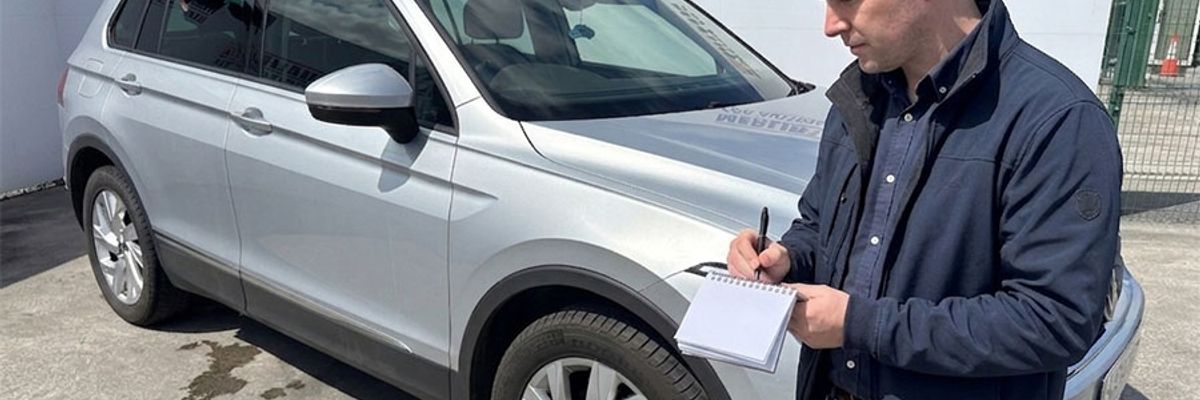
Read the window report. Every car carries one, giving a description of the vehicle and its lot number. It's your baseline. Read it properly rather than glancing at it in the hall.
View in person. Online listings are useful for shortlisting, but they are not a substitute for standing beside the car. Merlin's premises at M7 Motorpark, Junction 10 in Naas are open for viewing ahead of auction days — use them. Check panel gaps, tyre wear, interior condition, service history and anything the photographs conveniently don't show.
Run a vehicle history check. Outstanding finance, previous write-offs, mileage discrepancies and import history are all things a visual inspection will never reveal. This is the cheapest risk reduction available to you.
For electric vehicles, check battery health. A used EV's value hinges almost entirely on its battery state of health, and that is invisible from the outside. An AVILOO report provides an independent assessment of battery condition — worth understanding before bidding on any EV, because a degraded pack can cost more to replace than the car is worth.
Bring somebody who knows cars. If you're not confident assessing condition yourself, bring someone who is. It costs you a favour and a coffee.
Set a maximum and write it down. Auction rooms are designed to create momentum. Decide your ceiling — including fees, transport and any work you expect to need — before you arrive, and don't revise it upwards in the hall.
Here's a term almost nobody outside the trade knows, and it accounts for a lot of first-timer confusion.
Sellers can set a reserve price — a minimum they're willing to accept. If bidding stops below that reserve, the car isn't sold outright. Instead it becomes a provisional sale.
What happens next: the highest bidder places the standard deposit, and the sales team negotiates between buyer and seller to see whether an acceptable price can be agreed. Sometimes it can. Sometimes the seller holds firm and the car goes back into a future auction.
So if you're the top bidder and the hammer falls without a sale being confirmed, you haven't necessarily lost the car. You've entered a negotiation.
One related point worth flagging: on no reserve vehicles, there is no comeback whatsoever regardless of any issue that emerges. No reserve means the car sells to the highest bid, whatever that bid is — which can produce genuine bargains and genuine mistakes in roughly equal measure.
Two forms of identification are required to buy: photo ID such as a passport or driving licence, and a recent proof of address such as a utility bill or bank statement. Turn up without both and you won't be able to complete a purchase, regardless of what you've bid on.
Payment is accepted by cash, debit or credit card, or electronic funds transfer.
It probably suits you if:
It probably doesn't suit you if:
There's no shame in the second list. Plenty of people are better served by a dealer, and the extra cost buys something real. The mistake is landing in the second list and buying at auction anyway because the headline prices looked good.
If auction buying sounds like a fit, the next step is understanding the mechanics of the day itself — viewing, bidding numbers, the sales office and collection. Our Buying at Auction Guide walks through the full process step by step.
You can also check auction and viewing times to plan a viewing visit, or browse current auctions to see what's in the hall.
Merlin Car Auctions is a SIMI registered auction based at M7 Motorpark, Junction 10, Naas, Co. Kildare.